GaussianPulse
GaussianPulse (opens new window) defines a carrier-modulated Gaussian pulse.
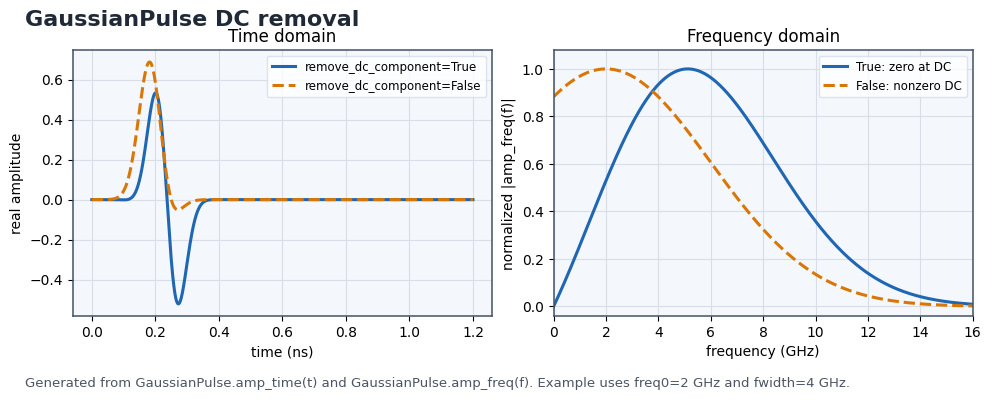
The plotted example compares both values of remove_dc_component using Tidy3D's amp_time and amp_freq methods.
Let A be amplitude, ϕ be phase, f0 be freq0, fw be fwidth, ω0=2πf0, σt=1/(2πfw), and tp=offsetσt.
When remove_dc_component is False, the pulse uses the unmodified Gaussian:
s(t)=iAeiϕe−iω0texp[−2σt2(t−tp)2] Its frequency-domain amplitude is:
s^(f)=fwiAeiϕ+i2π(f−f0)tpexp[−2fw2(f−f0)2] When remove_dc_component is True, Tidy3D applies a derivative-style correction. Define:
fp=21(f0+f02+4fw2),Δt={σt1−f02/fw2,0,fw>f0fw≤f0 and ts=tp+Δt. The time-domain pulse becomes:
s(t)=Aeiϕe−iω0texp[−2σt2(t−ts)2]2πfpiω0+(t−ts)/σt2 The corresponding frequency-domain amplitude is:
s^(f)=2πfpffwiAeiϕ+i2π(f−f0)tsexp[−2fw2(f−f0)2] Because of the leading f factor, s^(0)=0, so the DC component is removed.
Parameters
freq0: Central frequency of the pulse.
- Unit: Hz
- Constraint: greater than 0
- Required field
fwidth: Standard deviation of the frequency content of the pulse.
- Unit: Hz
- Constraint: greater than 0
- Required field
offset: Time delay of the pulse peak in units of 1/(2πfwidth).
remove_dc_component: Toggle whether to remove the DC component from the Gaussian pulse spectrum.
amplitude: Real-valued maximum amplitude.
phase: Phase shift of the time dependence.